A.28 Hudson River, NY
A.28.1 Contact:
EPRI Project Manager- Jeffrey A. Clock ([email protected])
A.28.2 Site Description
At the EPRI Reactive Capping Demonstration Project on the Hudson River in New York, sediments were located at water depths exceeding 50 ft, with tidal river currents often exceeding 4 fps. The sediments were located in a tidal, freshwater estuary. The contaminants of concern were coal tar NAPLs, and PAHs.
CSM summary: The site was adjacent to a former manufactured gas plant at which coal gas manufacturing byproducts were discharged into the river and which subsequently settled in sediments. NAPLs are present in surface and deeper sediments and can be visible at the sediment/water interface and as surface sheens.
A.28.3 Remedial Objectives
The objective of this demonstration project was to demonstrate the feasibility of using reactive cappingTechnology which covers contaminated sediment with material to isolate the contaminants from the surrounding environment. materials over deep water sediments to sequester NAPLs. This was a pilot scale, field demonstration of the technology.
A.28.4 Remedial Approach
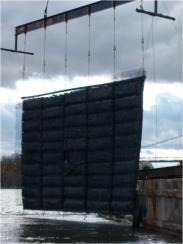
Laboratory studies using coal tar NAPLs were used to identify organoclay materials with the greatest absorptive capacity. CETCO reactive core mats attached to rock-filled Tensar Triton Marine Mattresses were used to place reactive material on sediment surfaces. Sand and sand/bulk organoclay mattress systems were also deployed. Total sediment surface area covered was 10,000 ft2, one-third of which was covered with each of the three capping systems.
Mattress systems were deployed and monitored for 18 months, after which they were removed and tested.
A.28.5 Monitoring
After deployment, the mattress systems were visually examined for physical integrity by divers at approximately four-month intervals. Mattresses retained original conditions for the duration of the project.
Sediment traps were deployed and observed. Two to twelve inches of sediments were redeposited over the mattress systems over the 18 month test period.
NAPL/PAH-sensitive materials (Tyvek and DART samplers) and SPME samplers were tested at each monitoring interval. No NAPL breakthrough was observed.
After removal of the mattress systems, samples of the reactive core mats were examined in the laboratory. Results indicated that, after 18 months of use, absorptive capacity and permeability1) Characteristic of a material or membrane that allows liquids or gases to pass through it; 2) The rate of flow of a liquid or gas through a porous material. of the organoclay in the mats was comparable to virgin material.
A.28.6 Costs
The total project cost was approximately $1.8 million, including testing and monitoring, assembly, deployment, and removal of mattress systems.
Reactive core mat/marine mattress systems (materials plus delivery to the site) cost $7 per ft2 and assembly and Installation costs were $70 per ft2.
A.28.7 Advantages and Limitations
Regulatory – even with support of the State DEC, permitting was challenging in that state and federal permits were required for this research project. Agencies involved included Army Corps of Engineers, US Fish and Wildlife Service, NYS DEC, NYS Office of Parks and Historic Preservation, NYS Dept. of State.
Technical – deployment of RCM at depth and in an area of high currents.
RCM was shown to be effective. Samples taken after 18 months of use show that absorptionAbsorption is the assimilation or incorporation of a gas, liquid, or dissolved substance into another substance. and permeability of the material was comparable to new material specifications. In addition RCM was shown to be more effective than sand or sand and bulk organoclay.
The mattress systems were subjected to numerous lifts during deployment and removal. Several mattress lifting systems failed while being removed from the test site. While most projects would not ordinarily require mattress removal, improved lifting systems would be needed where multiple lifts are contemplated.
Swift currents made precise deployment difficult. Further improvements in the method of deployment are suggested in similar environments.
A.28.8 Reference
EPRI. 2011. Capping for Coal Tar-Impacted Sediments: An In-Situ Evaluation of Effectiveness and Implementability (Phase II – Design, Installation and Monitoring)., Palo Alto, CA.
Publication Date: August 2014